
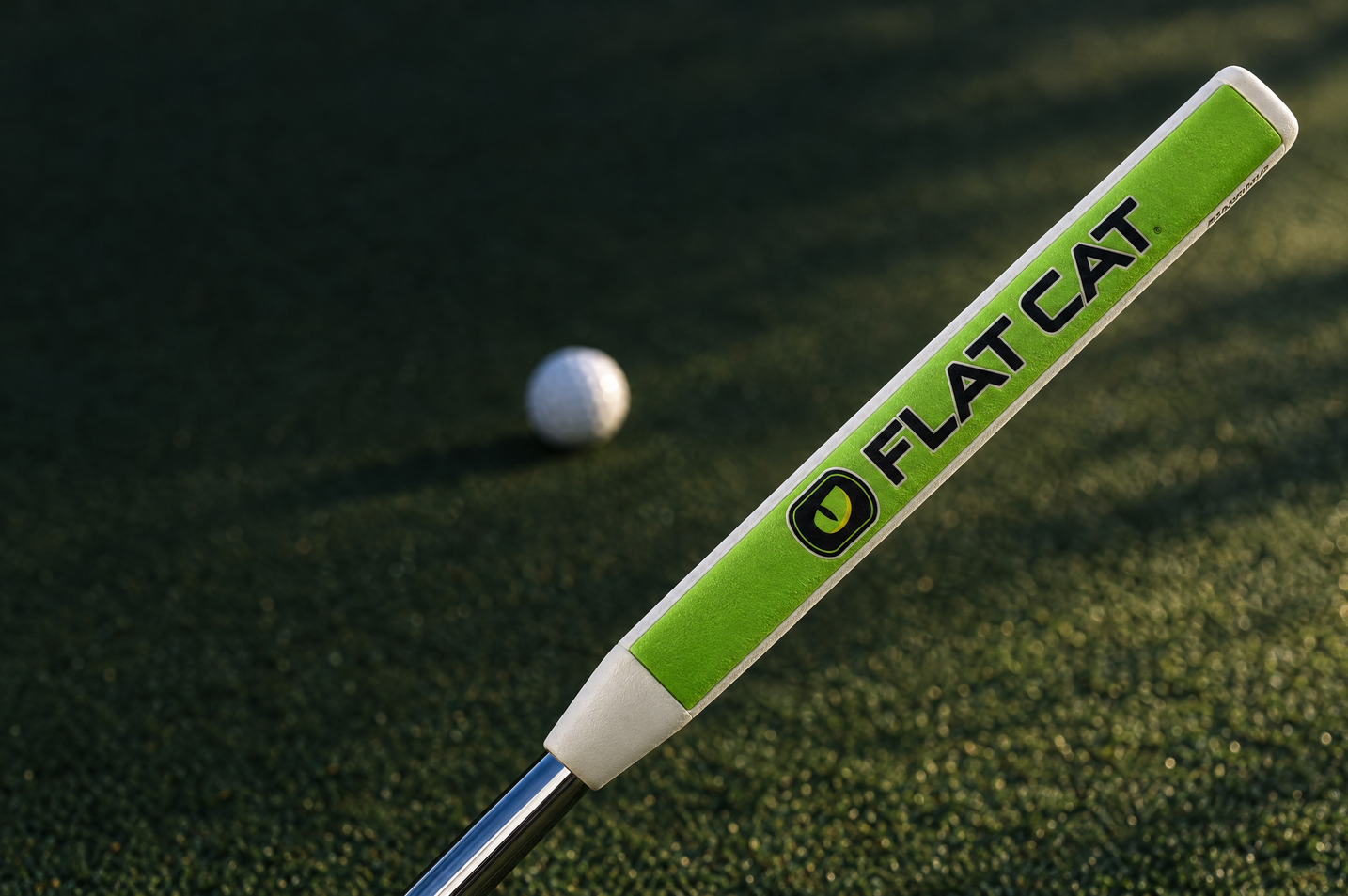
You can spend a surprising amount of time staring at putter grips. Fat ones. Skinny ones. Flat sides. Weighted ends. Every box seems to promise fewer three-putts.
The best putter grip is one that suits your usual hand position, feels comfortable at a relaxed pressure and works with the way you like your putter to feel. Start with shape and size, then compare surface feel and weight. A famous logo won’t make that decision for you.
This guide covers the grip fitted to the club, rather than whether you putt conventional, claw or left-hand-low. We’ll use the Flat Cat models listed at Regrip as examples, with the differences laid out plainly.
What are you trying to change?
Before buying anything, finish this sentence: “My current putter grip would be better if…”
Perhaps it feels too narrow. Perhaps you don’t like the surface. Perhaps the shape makes it awkward to put your hands where you want them. Those are useful starting points. “I missed four short putts on Saturday” is less helpful. We’ve all been there.
| What you notice | What to compare |
|---|---|
| Your hands feel cramped or stretched | Grip width and depth in your usual putting hold |
| You want a clearer flat surface under your hands | Rectangular profiles and the size of their flat sides |
| You dislike the surface more than the shape | Material and tackiness before making a large size change |
| You want to experiment with a heavier setup | Actual grip weight and a weighted model, ideally with a fitter |
Change one thing at a time where practical. If you replace a slim, light grip with a much larger, heavier one, it becomes harder to tell which difference you prefer.
Which putter grip shape suits your hands?
Look at the profile, not just the view of the logo. A grip with broad flat sides gives your fingers and palms different contact surfaces from a more rounded shape.
Flat Cat Original and TAK use the brand’s rectangular FLAT1 profile. That gives you pronounced flat faces to place your hands against. If you like the idea but prefer a narrower grip, there are smaller versions; rectangular doesn’t automatically mean enormous.
A pistol profile is another option to compare. For example, Flat Cat describes its Solution Pistol as having a flat top and rounded bottom. It is a different shape from the rectangular Solution versions, so check the selected variant rather than relying on the main product photo.
If you can try grips in person, use your normal putting hold. Where do your thumbs land? Do both hands settle comfortably? Do you need to rearrange your fingers to accommodate the shape? A shape that feels good in someone else’s hands can still be wrong in yours.
Is an oversized putter grip better?
Bigger is an option, not a promotion. Choose the size you can hold comfortably rather than assuming the largest one must be the most forgiving.
Compare width and depth together. Flat Cat’s Svelte size, for example, combines a narrower width with larger flat sides. It shows why two grips can feel different even when both are described as relatively slim.
When comparing sizes, ask yourself:
- Can I place both hands naturally without reaching around the grip?
- Does the shape remain comfortable when I take my putting stance?
- Am I choosing this because it feels right, or because the name sounds right?
Don’t automatically carry your iron-grip size across to the putter. Try the putter profile in your putting hold, and check the dimensions of the exact model. Size names alone don’t tell you enough.
Soft, tacky and heavy mean different things
Keep these decisions separate. Soft describes cushioning. Tacky describes surface grip. Weight is a specification you can compare in grams. One word doesn’t tell you the other two.
Flat Cat Original uses lightweight polyurethane with a lighter-traction surface. TAK uses a tackier rubber compound over a foam core. That makes the pair worth comparing if you like the rectangular shape and want to choose between surface feels.
They also differ in weight. The Original Standard is listed at 60 g; TAK Standard is 92 g. Those are manufacturer specifications, not results from a Regrip test. Even with the same size label, this isn’t simply a colour swap.
Solution takes the weight decision further, adding a stainless steel weighted cone below the hands. Its rectangular Svelte version is listed at 120 g. Treat that as a deliberate equipment change: compare it with your existing grip and, if possible, try a fitted example before committing. No grip is a guaranteed fix for a putting fault.
Flat Cat Original vs TAK vs Solution
These are the three model families listed in Regrip’s putter-grip collection. The table is a guide to their construction and differences, rather than a ranking based on testing.
| Model | Main difference | Worth comparing if… |
|---|---|---|
| Original | Rectangular profile; lightweight polyurethane | You want the flat-sided shape with a lighter grip |
| TAK | Rectangular profile; tackier rubber surface | You like flat sides and prefer more surface tack |
| Solution | Weighted cone; rectangular and Pistol variants are listed | You specifically want to explore a weighted option |
Check each product’s current size selector, specifications and availability before ordering. Not every model comes in every size, and the selected variant matters.
What should you check before fitting it?
Choosing the outside shape is only part of the job. Before removing your current grip:
- Confirm the fit. Check the replacement grip’s core size against your putter shaft’s butt diameter. If the specification is unclear, ask before ordering.
- Plan the orientation. Follow the grip manufacturer’s alignment instructions. A shaped putter grip needs to be fitted in the intended relationship to the putter face.
- Have the supplies ready. Flat Cat’s installation guidance calls for grip tape and solvent, which are supplied separately from the grip.
- Allow the specified drying time. Follow the instructions for the fitting products you actually use; don’t assume every solution is ready to play at the same time.
Our installation guide covers the basic regripping process. The kit buying guide explains the tools and consumables, and the Australian regripping-cost guide helps you compare doing it yourself with paid fitting. A club fitter is a sensible option if you’re unsure about compatibility or alignment.
Make a shortlist you can actually use
Write down your preferred shape, approximate size and surface feel. Then check the weight of the exact version you’re considering. You’ve now got something more useful than “the one everyone’s using”.
For the Flat Cat range, compare Original and TAK if your main choice is surface feel within a rectangular profile. Look at Solution when the extra weight is part of what you want to try. Check the Pistol variant separately if that’s the shape you prefer.
Compare Regrip’s putter grips →
Product references: Flat Cat Original specifications, TAK specifications, Solution specifications, Solution Pistol and Flat Cat’s sizing and installation FAQ. Checked 14 October 2026.